Nov 7, 2025
Predictive analytics consists of using data, advanced statistical algorithms, and machine learning techniques to anticipate outcomes based on historical data.
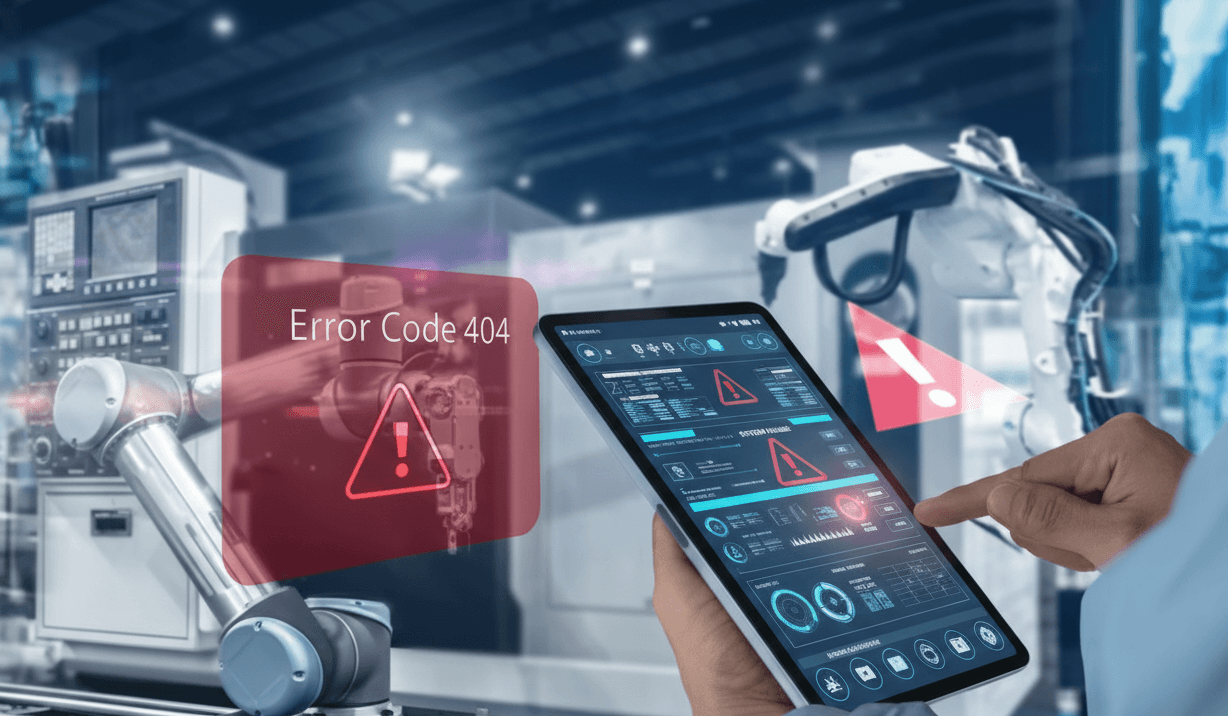
The importance of predictive analytics lies in its ability to help organizations accurately estimate what is most likely to happen in their processes or operations. In the industrial sector, this translates into anticipating equipment failures, reducing energy consumption, or detecting process anomalies before they occur.
Predictive analytics relies fundamentally on machine learning (ML). Models are trained using large volumes of data from sensors and operational processes to identify patterns and make increasingly accurate predictions. As RT Insights highlights, “machine learning models are being embedded within data pipelines, learning from live data streams and adapting predictions on the fly.”
The no-codeapproach can be understood as a digital philosophy that allows users to leverage the power of machine learning for multiple purposes without the need to program. This approach is also known as 'visual programming' or 'programming without code,' according to BBVA.
No-code predictive analytics is made possible thanks to no-code ML platforms: tools that allow users to build, train, and deploy predictive models without writing a single line of code.
And here’s the key: if you want to apply predictive analytics, you are already talking about machine learning. No-code platforms are simply the fastest and most accessible way to get started.
What is no-code machine learning?
No-code machine learning refers to the ability to create, train, and deploy predictive models through intuitive, visual interfaces without programming knowledge. Instead of relying exclusively on data scientists and languages like Python, these platforms democratize access to machine learning, enabling operations, maintenance, and innovation teams to use it directly.
These platforms simplify technical complexity through drag-and-drop workflows, include AutoML engines that automatically select and optimize algorithms, and offer built-in tools to validate and visualize model performance with just a few clicks. As a result, machine learning becomes accessible, fast, and scalable, allowing organizations to turn raw, disconnected data into predictive insights in days, not months.
This approach is particularly valuable in data-intensive sectors such as:
How do no-code ML platforms work?
No-code machine learning platforms internally automate the technical tasks of the machine learning workflow, such as data preparation, algorithm selection, or model optimization, and translate them into a guided, visual interface for the user.
Essentially, they encapsulate the complexity of machine learning into a series of interconnected modules. Behind each visual action, automatic processes are executed that would normally require programming skills and technical expertise.
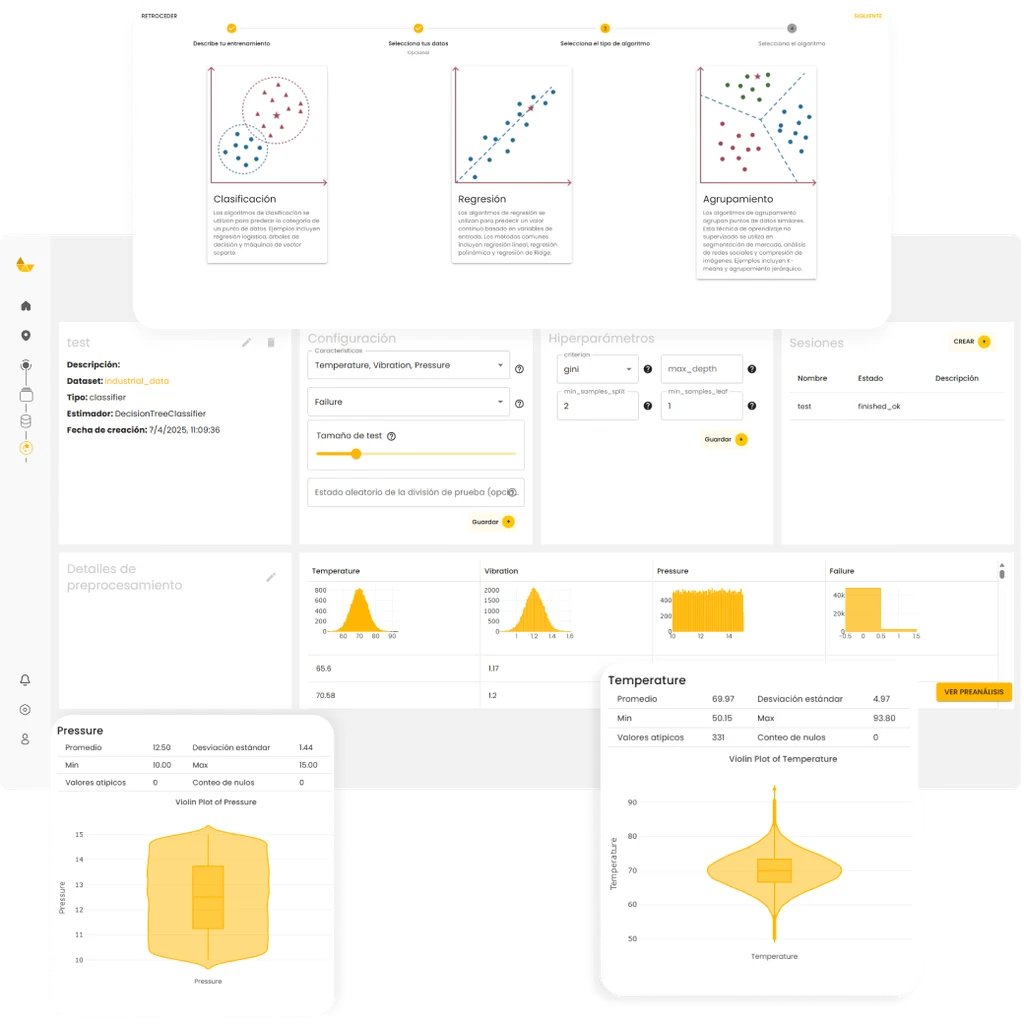
In the case of platforms like TOKII, the general workflow can be understood as follows:
Data ingestion and management
The user connects their data sources, while the system validates them, cleans inconsistencies, and suggests necessary transformations.
Defining the type of learning
Depending on the problem, users can choose between supervised learning (classification or regression) or unsupervised learning (clustering).
Selecting specific algorithms
The platform suggests or allows users to choose from a range of algorithms according to the selected problem: decision trees, random forests, neural networks, K-means, and others.
Model configuration
Users define input variables, the target variable (if applicable), test size, and other parameters.
Data preprocessing
Options such as scaling, encoding categorical variables, or handling missing values can be applied through intuitive controls.
Training and model comparison (new sessions)
The training is launched, and multiple sessions with different configurations can be created to compare results.
Model analysis and evaluation
Once the model is trained, the platform presents metrics relevant to the chosen problem type, such as accuracy, confusion matrix, ROC curve, R², or number of clusters.
Prediction and result interpretation
The final model is applied to new datasets to generate predictions, which can be visualized in real time or integrated into digital dashboards.
This step-by-step approach allows teams across departments, from operations to strategy, to experiment, iterate, and deploy predictive models without writing a single line of code.
No-code machine learning models in industrial environments
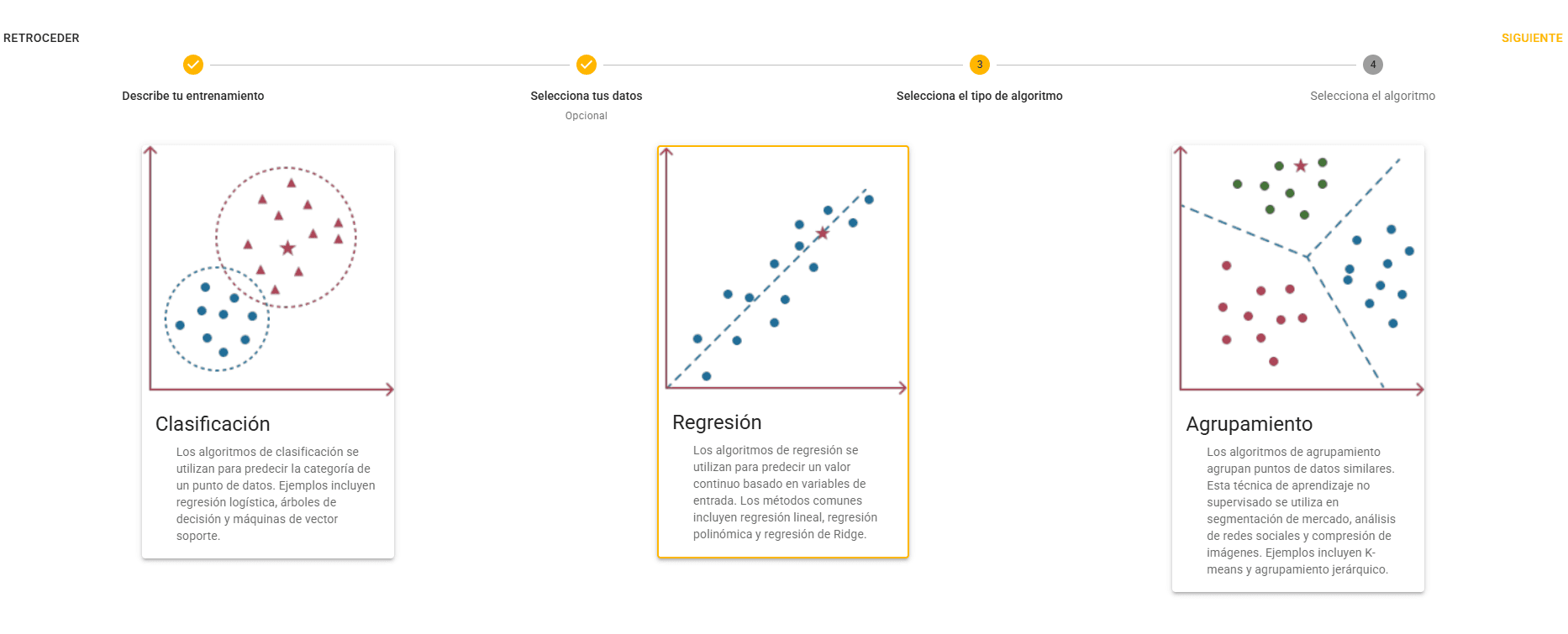
These are the three main types of predictive models that you can create and deploy with TOKII, without needing to program:
1. Data classification models
Classification models assign a category or label to each data point. They’re ideal when the outcome to predict is a discrete result.
Detecting anomalies in sensors (“normal” / “critical”).
Predicting operational states of machinery (“active,” “under review,” “failed”).
Classifying energy consumption by levels (“high,” “medium,” and “low”).
Assigning incidents to a category (“electrical,” “climate control,” or “structural”).
2. Regression models
Regression models predict continuous numerical values, ideal for dynamic estimations and forecasts.
Predicting a building’s energy consumption based on environmental variables.
Estimating expected temperature in an HVAC system.
Calculating the expected daily output of a manufacturing line.
Forecasting a component’s remaining useful life.
3. Cluster analysis
Clustering is an unsupervised technique that groups data according to similarity, without predefined labels.
Segmenting sensors or equipment based on similar operational behavior.
Grouping energy consumption patterns by zone.
Detecting anomalous behavior (outliers).
Classifying assets based on historical maintenance or performance data.
Benefits of no-code ML platforms
For many industrial companies, the main barrier to adopting machine learning has been the complexity, not the lack of data.
No-code platforms remove that barrier, making AI accessible to engineers, analysts, and decision-makers without requiring specialized teams. According to Fortune Business Insights, “AI no-code platforms dramatically reduce the demand for expert AI solutions, lowering development costs for industries of all sizes.”
Key benefits:
Fast deployment: From data to model in a few hours or days.
Lower technical barrier: No programming skills required. Business experts can lead AI projects.
Cost efficiency: Reduced need for external consultants or large in-house data science teams.
Scalable insights: Can be applied in different plants or business units.
Real-time value: Models can be deployed into operational dashboards or digital twins for smarter, faster decisions.
Agile iteration: Easy to test, compare, and refine multiple model configurations.
For companies, this translates into less downtime, better resource allocation, and greater competitiveness.
With platforms like TOKII, industrial teams can build, train, and deploy machine learning models with just a few clicks, turning data into real-time decisions without writing code.
Want to explore predictive analytics but don’t know where to start? Request a personalized DEMO of TOKII and let our team of experts guide you step by step.