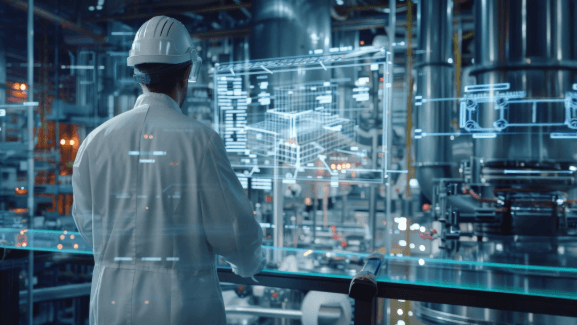
In an increasingly data-driven and connected industrial environment, the adoption of digital twins is emerging as a strategic solution for companies seeking to optimize their processes and outcomes. These digital replicas provide a detailed view of assets and systems through analysis and mathematical calculations, cross-referencing historical and real-time data with the goal of improving decision-making.
Implementation and Development
Before implementing a digital twin, it is crucial to assess the existing technological infrastructure and system capabilities. This analysis should include a review of the IT architecture, hardware and software compatibility, and the robustness of existing network connections.
The development of a digital twin begins with the creation of its digital counterpart. This process comprises several fundamental technical stages, such as project requirement analysis, solution design, and its development and commissioning as a detailed model that replicates the characteristics and behavior of the physical asset.
In parallel, the necessary connections are established to integrate data from sensors, IoT devices, APIs, or databases, among others. These data streams feed the digital twin and require an appropriate development platform. Various platforms exist, such as AWS, Microsoft Azure, MATLAB/Simulink, Apache Kafka, Unity, Unreal Engine, Dassault Systèmes ENOVIA, among others. The choice of platform is based on several factors, including system compatibility, acquisition cost, ease of integration, maintenance, and the flexibility and scalability needed to support project growth.
At IMMERSIA, we specialize in technologies capable of representing physical-world systems along with their associated data within a single dynamic digital environment. This hybrid environment is achieved through the integration and connection of advanced visualization and analytics tools (VR, AR, MR), which enable intuitive interaction. Thus, TOKII, our platform specifically configured for the creation and management of digital environments, integrates real-time and historical data, enabling precise and detailed simulations of physical assets. This platform not only allows visualization but also continuously analyzes and improves various systems and processes, optimizing operational efficiency and reducing costs. TOKII provides users with meticulous control; in addition to its integrated modules, it offers a digital environment editor along with the ability to create incidents and intelligent alerts and attach documentation within the same interface, making it one of the most comprehensive platforms available on the market.

Challenges of Implementation
Integrating legacy systems with new digital technologies, ensuring solution scalability, and protecting data security represent the primary technical challenges in implementing a digital twin. At IMMERSIA we adopt a modular approach to its integration and a robust cybersecurity policy through user accounts, passwords, and different controlled access levels that help mitigate these potential issues.
Resistance to change is another common factor in many organizations. To overcome this, it is essential to foster a culture that values digitalization and highlights the tangible benefits offered by digital twins. Demonstrating positive results through success stories can help counteract this resistance and build trust in the implementation of new technologies.
Finally, it is also crucial to ensure that teams are trained to use these tools. At IMMERSIA, we dedicate considerable attention and resources to training and ongoing support to ease this transition, because no matter how advanced a technology may be, we know it can only reach its full potential with properly prepared teams. We offer tailored training programs and continuous technical assistance with the goal of enabling our clients and partners to take full advantage of our platform TOKII and integrate it into their daily workflows.
Over the years, Immersia has successfully implemented digital twins across various sectors. You can check our USE CASES.
Are you interested in learning how we could implement digital twin technology in your production plant? Request a DEMO.